- The Strategic Tax Advisor
- Posts
- Inherited IRA Rules 2025: Annual RMDs, Tax Strategies, and the 25% Penalty
Inherited IRA Rules 2025: Annual RMDs, Tax Strategies, and the 25% Penalty
Why 2025 Changes Everything for Inherited IRAs and Your Complete Action Plan for Compliance, Tax Savings, and Distribution Strategy

Prashanth Srikanthan
December 03, 2025
Disclaimer: This article provides general educational information about inherited IRA rules and is not personalized tax, legal, or financial advice. Consult with qualified professionals for guidance
When you inherit an IRA, you're receiving more than just money. You're stepping into a complex web of tax rules, distribution requirements, and strategic decisions that can dramatically impact how much you actually keep. The difference between making the right moves and the wrong ones? That could easily mean $100,000 or more over the next decade.
The IRS finalized regulations in 2024 that fundamentally changed inherited IRA distributions starting January 1, 2025. If you inherited an IRA after 2019 from someone who had already started taking Required Minimum Distributions (RMDs), you must now take annual RMDs during the 10-year period, not just empty the account by year 10. The IRS penalty waiver that protected beneficiaries from 2020-2024 has expired. Missing your 2025 RMD triggers a 25% penalty on the amount you should have withdrawn.
The rules governing inherited IRAs changed significantly with the SECURE Act of 2019, SECURE Act 2.0 in 2022, and now the 2024 IRS final regulations effective for 2025. If you inherited an IRA before 2020, what you've heard from friends or read online might be completely outdated. The old "stretch IRA" strategy that allowed beneficiaries to take minimal distributions over their entire lifetime? Gone for most people. The landscape has fundamentally shifted, and understanding the current rules is critical to preserving your inheritance.
The 2025 Rule Change That Affects Inherited IRA Distributions
Starting January 1, 2025, the IRS began enforcing annual Required Minimum Distribution (RMD) requirements for inherited IRAs that were previously waived from 2020-2024. This is not a minor technical update. This changes the tax planning landscape for hundreds of thousands of beneficiaries who inherited IRAs since 2020.
What Changed:
From 2020-2024, the IRS issued guidance waiving penalties for beneficiaries who failed to take annual RMDs during the 10-year distribution period. Many beneficiaries and tax professionals interpreted this as meaning annual RMDs weren't actually required. That interpretation is now definitively wrong.
The IRS final regulations issued in July 2024 confirmed that if the original IRA owner had already started taking RMDs before death (had reached their Required Beginning Date), beneficiaries must take annual RMDs during years 1-9 of the 10-year period AND empty the account by December 31 of year 10.
The Penalty for Missing 2025 RMDs:
25% excise tax on the amount you should have withdrawn. On a $50,000 required distribution, that's a $12,500 penalty. Plus you still owe income taxes on the distribution when you eventually take it. The IRS is not sending reminder notices about these requirements.

Annual RMD Requirements Based on Original Owner's Age and RMD Status at Death
RBD = Required Beginning Date for RMDs, which is April 1 following the year the owner turns 73 (or 75 for those born in 1960 or later)
Real-World Impact: What This Means If You Inherited in 2020-2024
Let's say you inherited a $400,000 IRA in 2022 from your mother who was 78 when she passed (she had been taking RMDs). Under the waiver, you didn't take RMDs in 2023 or 2024. You might have thought you could wait until 2032 (year 10) to take everything.
What You Actually Owe in 2025:
You must take your 2025 RMD by December 31, 2025, or face a 25% penalty. Your RMD is calculated by dividing the December 31, 2024 account balance by your life expectancy factor from the IRS Single Life Expectancy Table. If you're 50 years old, your life expectancy factor is approximately 36.2 years.
2025 RMD calculation: $400,000 ÷ 36.2 = $11,050
Miss this deadline, and you owe a $2,763 penalty (25% of $11,050) plus income taxes on the $11,050 when you eventually take it.
For years 2023 and 2024, the IRS waived the penalty, so you don't owe back penalties for those years. But you must take RMDs for 2025, 2026, 2027, 2028, 2029, 2030, and 2031, then empty the account completely by December 31, 2032.
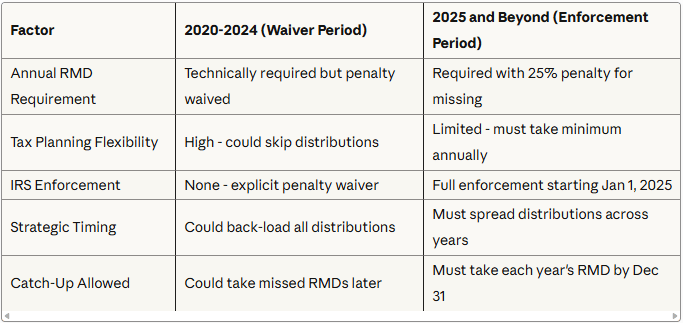
How Inherited IRA Rules Changed from the Waiver Period to Full Enforcement
Understanding Who You Are in the Eyes of the IRS
The first and most important thing to understand is that the IRS doesn't treat all beneficiaries equally. Your relationship to the person who died determines almost everything about how you can handle the inherited IRA. The IRS categorizes beneficiaries into 3 distinct groups, and your group membership dictates your options, your timelines, and your tax consequences.
The Spousal Beneficiary: Maximum Flexibility
If you inherited an IRA from your spouse, you've won the beneficiary lottery in terms of flexibility. Spousal beneficiaries have options that no one else gets, and these options can save you tens of thousands in taxes over your lifetime.
Your Unique Options as a Surviving Spouse:
You can treat the inherited IRA as your own by rolling it over into your existing IRA or a new IRA in your name. This is the most powerful option because it resets the clock entirely. The IRA becomes yours, you're not subject to any immediate distribution requirements, and you won't face required minimum distributions (RMDs) until you reach age 73 (or age 75 if you were born in 1960 or later).
Alternatively, you can remain as a beneficiary of the inherited IRA rather than rolling it over. This choice becomes valuable if you're younger than 59½ and might need access to the money before traditional retirement age. Here's why: normally, if you withdraw money from your own IRA before age 59½, the IRS charges a 10% early withdrawal penalty on top of regular income taxes. But when you remain as a beneficiary of an inherited spousal IRA, the IRS waives this 10% penalty entirely, recognizing that your spouse's death might create immediate financial needs.
For example, if you're 52 years old and your spouse just passed away, you might need funds to adjust to single-income living or cover unexpected expenses. By remaining as a beneficiary, you can withdraw $50,000 and pay only income tax on it. If you had rolled it into your own IRA, that same $50,000 withdrawal would cost you an additional $5,000 penalty.
However, this flexibility comes with a requirement. You must begin taking annual required minimum distributions based on your life expectancy starting the year after your spouse's death. The IRS calculates these RMDs by dividing the account balance by your remaining life expectancy, forcing you to withdraw a portion each year whether you need the money or not. This means you lose the ability to let the entire account grow untouched until you reach age 73 like you could with your own IRA.
You can also delay the decision by keeping the inherited IRA in your deceased spouse's name initially, then converting it to your own IRA later when it's more advantageous. This flexibility is exclusively available to spouses.
A Real-World Scenario:
Consider Maria, age 62, who just inherited her husband's $650,000 traditional IRA. Her husband was 67 when he passed away. Maria has her own IRA worth $280,000 and is still working, earning $110,000 annually.
If Maria rolls over the inherited IRA into her own IRA, she now has a combined IRA of $930,000. She won't face RMDs until age 73, giving her 11 more years of tax-deferred growth. If the IRA grows at 6% annually, by age 73 it could be worth approximately $1,760,000 before RMDs begin. Her first RMD at age 73 would be roughly $66,000 (using the 26.5 distribution period), which might push her into a higher tax bracket.
If Maria instead remains as a beneficiary, she must begin taking RMDs immediately based on her own life expectancy of approximately 24.6 years (using the IRS Single Life Expectancy Table). Her first RMD would be about $26,400. Over 10 years, she'd be required to take out approximately $330,000, paying taxes on that amount at her current marginal rate of 24%.
The spousal rollover option gives Maria control over timing, potentially allowing her to delay distributions until after she retires when her tax rate might be lower. This is why the spousal rollover is typically the preferred strategy for most surviving spouses.
Non-Spouse Designated Beneficiaries: The 10-Year Rule
If you're not the spouse but you're a named individual beneficiary (a child, sibling, friend, parent, or anyone else), you fall into this category. This is where the SECURE Act made the biggest changes, and where beneficiaries often make costly mistakes.
The 10-Year Distribution Rule:
You must empty the entire inherited IRA by December 31 of the 10th year following the year of the original owner's death. There are no annual RMDs during the 10-year period if the original owner died before their required beginning date (RBD) for RMDs. However, if the original owner had already started taking RMDs, you must continue taking annual RMDs during the 10-year period, and still empty the account by year 10.
This might sound simple, but the tax implications are where people get into trouble. You have flexibility in how much you take each year, but you need to think strategically about when to take distributions to minimize your tax burden.
Understanding Your Tax Planning Window:
To illustrate how different distribution strategies affect your tax burden, we'll walk through three detailed approaches using a specific scenario. All three approaches use the same starting conditions so you can see exactly how timing and strategy choices create different outcomes.
SCENARIO FOR ALL THREE APPROACHES:
Your Situation:
You inherit a $500,000 traditional IRA from your parent
Your parent was 76 years old when they passed away
Your parent had already started taking their own RMDs before death
You are 45 years old at the time of inheritance
You earn $85,000 per year from your job (this stays consistent except where noted)
You are a single filer
The inherited IRA grows at 6% annually
You must take annual RMDs during the 10-year period AND empty the account by December 31 of year 10
What This Means: Under the 2025 IRS final regulations, because your parent had already started RMDs, you cannot simply wait until year 10 to take everything. You must calculate and take a minimum required distribution each year based on your life expectancy, then distribute whatever remains by the end of year 10.
Your year 1 RMD calculation: $500,000 ÷ 38.8 (your life expectancy at age 45) = $12,887
All tax calculations in the three approaches below assume you're filing as a single taxpayer with $85,000 in earned income (except in Approach 3, year 6, where your income temporarily drops to $20,000 during a sabbatical).
Before we look at different distribution strategies, you need to understand an important limitation that the 2025 rules place on your flexibility. This limitation fundamentally affects which strategies are even available to you and why some approaches that might sound appealing are actually not permitted under current IRS regulations.
Understanding the 2025 Annual RMD Requirement
The 2025 rule change creates an important distinction that affects how you can manage distributions. If your parent had already started taking their own required minimum distributions before they passed away, this triggers a specific requirement for you as the beneficiary. You cannot defer all distributions until year 10. Instead, you must take a calculated amount each year during the 10-year period, and then empty whatever remains by December 31 of year 10.
Here's why this matters and how it works. The IRS requires you to calculate an annual RMD by dividing the inherited IRA balance by your remaining life expectancy from their Single Life Expectancy Table. Think of it as the IRS saying "we're going to spread this inheritance out over your expected remaining lifetime, but we're also going to make sure it's completely distributed within 10 years." You face two simultaneous requirements: take a minimum amount annually, and empty the account by year 10.
This requirement fundamentally changes your tax planning flexibility. Without it, you could strategically time all your distributions to occur in years when your income is lower. With it, you face a floor for distributions each year regardless of your tax situation. If you were planning to take a sabbatical in year 6 and wanted to take most of the inheritance that year when your income drops, you'd still need to take the minimum RMD in years 1 through 5 even though you'd prefer to wait. You gain flexibility only in choosing to take more than the minimum in any given year.
Your Annual RMD Calculation:
Year 1 RMD: $500,000 ÷ 38.8 (your life expectancy at age 45) = $12,887
Each subsequent year, you divide the prior year-end balance by your remaining life expectancy (which decreases by 1 each year).
Now that you understand the annual RMD requirement, here are 3 different distribution approaches and their tax consequences:
Approach 1: Take Only Required RMDs, Then Empty in Year 10
This approach takes the minimum required each year, letting the balance grow, then takes everything remaining in year 10.

Year-by-Year Account Balance With Minimum RMDs Only ($500,000 Inherited IRA)
Summary of Approach 1:
Total distributions: $815,750
The account balance grew significantly during years 1-9 because you only withdrew the minimum RMD each year, allowing compound growth at 6% annually on the remaining balance. By year 10, the account had grown from the original $500,000 to $665,434, despite taking annual distributions. This demonstrates the power of tax-deferred compound growth, but as you'll see, it comes at a steep tax cost in the final year.
Federal tax impact:
Years 1-9: $33,662 total
Year 10: Approximately $232,135 on IRA portion
Total federal taxes: $265,797
Your effective tax rate on the total distribution is approximately 32.6% ($265,797 ÷ $815,750). This high rate occurs because the massive year 10 distribution of $665,434 pushes you deep into the highest tax brackets. While years 1-9 were efficient (22-24% brackets), year 10 alone accounts for 87% of your total tax bill ($232,135 out of $265,797). You'll pay $104,102 more in total taxes using this approach compared to Approach 2.
After-tax amount in your pocket: $549,953
Here's the critical insight that often surprises people: despite paying the most in taxes of all three approaches, Approach 1 puts the most money in your pocket after all taxes are paid. The extra $139,805 in distributions (generated by letting the account grow longer) more than compensates for the extra $104,102 in taxes. You end up with $35,703 more than Approach 2 and $21,923 more than Approach 3.
This illustrates an important principle: minimizing your tax rate and maximizing your after-tax wealth are not the same goal. Sometimes accepting a higher tax burden makes sense if doing so allows significantly more investment growth. Approach 1 is the least tax-efficient strategy but the most wealth-maximizing strategy.
Approach 2: Strategic Annual Distributions Above the Minimum
Instead of waiting until year 10, you take larger distributions each year while still meeting the RMD requirements.

Strategic Distribution Schedule With Accelerated Withdrawals
Summary of Approach 2:
Total distributions: $675,945
This total is higher than the original $500,000 inheritance because the account continued growing at 6% annually throughout the distribution period. However, by accelerating distributions to $80,000 annually starting in year 3, you significantly reduced the account balance available for continued growth. The account had only $89,397 remaining by year 10, compared to $665,434 in Approach 1. You distributed $139,805 less than Approach 1 because less money remained invested to generate compound returns.
Total federal taxes: $161,695
Your effective tax rate on the total distribution is approximately 23.9% ($161,695 ÷ $675,945). This rate is the most efficient of all three approaches because your distributions ($80,000 annually in years 3-9) kept you solidly in the 24% marginal bracket without pushing you into the higher 32% bracket that begins at $197,301 for single filers. By spreading distributions evenly across all 10 years and avoiding a large year 10 spike, you minimized your total tax burden. You paid $104,102 less in taxes than Approach 1 and $40,307 less than Approach 3.
After-tax amount in your pocket: $514,250
Here's the trade-off that matters: while Approach 2 is the most tax-efficient strategy (lowest effective tax rate and lowest total taxes paid), it puts the least money in your pocket after all taxes are paid. You end up with $35,703 less than Approach 1 and $13,780 less than Approach 3.
Why does this happen? By taking larger distributions earlier (years 3-9), you removed money from the tax-deferred account that could have continued growing at 6% annually. You "paid" for tax efficiency by sacrificing investment growth. The $104,102 you saved in taxes is less valuable than the additional $139,805 in distributions that Approach 1 generated through continued compound growth.
When this approach makes sense: If you need consistent cash flow during the 10-year period for living expenses, debt payments, or other financial goals, Approach 2 provides predictable annual distributions without a massive year 10 spike. If your primary concern is avoiding a single year of very high income (which might affect other benefits, trigger IRMAA surcharges, or complicate your tax situation), the tax smoothing of Approach 2 has value beyond the raw dollars. But if your goal is simply to maximize the after-tax wealth you extract from the inherited IRA, Approach 1 delivers more money to your pocket.
Approach 3: Time Distributions Around Income Changes
You plan to take a sabbatical in year 6 when your income drops to $20,000.

Optimizing Distributions Around a Sabbatical Year (Low-Income Window)
Summary of Approach 3:
Total distributions: $730,032
This approach produces a moderate total distribution - more than Approach 2 ($675,945) but less than Approach 1 ($815,750). By taking only minimum RMDs in years 1-5 and 7-9, the account continued growing. However, the large $250,000 distribution in year 6 (sabbatical year) removed a substantial amount from tax-deferred growth. You distributed $85,718 less than Approach 1 but $54,087 more than Approach 2.
Total federal taxes: $202,002
Your effective tax rate on the total distribution is approximately 27.7% ($202,002 ÷ $730,032). This falls between Approach 1's high rate (32.6%) and Approach 2's low rate (23.9%). The sabbatical year strategy provides significant tax savings compared to Approach 1 because you absorbed $250,000 during a year when your regular income was only $20,000, keeping much of that distribution in lower brackets. However, you still faced a substantial year 10 distribution ($389,439) that created a tax spike, making this approach less tax-efficient than Approach 2. You paid $63,795 less in taxes than Approach 1 but $40,307 more than Approach 2.
After-tax amount in your pocket: $528,030
Approach 3 delivers a middle-ground result. You end up with $13,780 more in your pocket than Approach 2 and $21,923 less than Approach 1. This positioning makes sense: you preserved some tax-deferred growth by delaying large distributions until year 6, generating more total distributions than Approach 2. However, you couldn't empty the entire account during the sabbatical window, leaving a large balance that created a year 10 tax spike, which reduced your after-tax wealth compared to Approach 1's maximum growth strategy.
When this approach makes sense: If you have a predictable temporary income reduction (sabbatical, career break, early retirement, maternity/paternity leave, or starting a business with low initial income), timing a large IRA distribution during that window can significantly reduce taxes while still generating substantial after-tax wealth. Approach 3 represents a "strategic opportunism" approach - you take advantage of a specific tax planning window when it appears. This delivers more wealth than the tax-smoothing approach (Approach 2) while avoiding some of the year 10 tax spike that Approach 1 creates. If your life circumstances include such a window, this approach offers a valuable middle path.
Comparison Summary: All Three Approaches

Complete Financial Comparison of Three Distribution Strategies
The surprising truth about inherited IRA distribution strategies:
Approach 1 puts $35,703 more in your pocket than Approach 2, despite having the highest tax burden ($265,797 vs. $161,695 - a difference of $104,102 in taxes). How is this possible? The extra $139,805 in distributions (generated by maximizing tax-deferred growth) more than compensates for the extra taxes paid.
This reveals a critical insight: the strategy that minimizes your taxes is not the same as the strategy that maximizes your wealth. Sometimes it makes financial sense to accept a higher tax bill if doing so enables significantly more investment growth.
Which approach is right for you depends on your goals:
Choose Approach 1 if: Your primary goal is maximizing the total after-tax wealth you extract from the inherited IRA. You don't need significant distributions during years 1-9, you can handle the large tax bill in year 10 (potentially by withholding taxes from the distribution itself), and you're comfortable with one year of very high income. This approach requires the least active management - you simply take your RMD each year and let the account grow.
Choose Approach 2 if: You need predictable cash flow during the 10-year period, want to avoid a single year of extremely high income (which could affect Medicare premiums, other benefits, or complicate your financial situation), or value tax smoothing and certainty over maximum wealth accumulation. While this approach puts less money in your pocket than Approach 1, it provides consistent annual distributions and the lowest tax rate.
Choose Approach 3 if: You have a predictable temporary income reduction window (sabbatical, career break, early retirement bridge year, business startup period) where you can absorb a large distribution at favorable tax rates. This approach requires precise timing and planning but delivers a middle-ground outcome: more wealth than Approach 2 while avoiding some of Approach 1's tax spike.
Eligible Designated Beneficiaries: The Exception to the 10-Year Rule
The SECURE Act created a special category of beneficiaries who get more favorable treatment. These "Eligible Designated Beneficiaries" can still use a form of the old stretch IRA strategy, taking distributions over their life expectancy rather than facing the 10-year rule.
Who Qualifies as an Eligible Designated Beneficiary:
You're an Eligible Designated Beneficiary if you're:
The surviving spouse
A minor child of the deceased (but only until they reach age 21, then the 10-year rule kicks in)
Disabled as defined by the IRS
Chronically ill as defined by the IRS
An individual who is not more than 10 years younger than the deceased
That last category often surprises people. If your 75-year-old brother names you as beneficiary and you're 68, you're within 10 years of his age, so you qualify for stretch treatment. But if you're 66 when he dies at 80, you're more than 10 years younger, so you face the 10-year rule.
The Life Expectancy Method for Eligible Designated Beneficiaries:
If you qualify as an Eligible Designated Beneficiary (other than as a spouse, since spouses have their own special rules), you calculate your RMD each year by dividing the IRA balance by your remaining life expectancy from the IRS Single Life Expectancy Table.
An Example with Real Numbers:
Let's say Thomas, age 71, inherited a $400,000 IRA from his 79-year-old sister who passed away last year. Because Thomas is within 10 years of his sister's age, he qualifies as an Eligible Designated Beneficiary.
Thomas looks up his life expectancy in the IRS Single Life Expectancy Table and finds he has 17.0 years (for age 71 in the year after his sister's death).
His Year 1 RMD: $400,000 ÷ 17.0 = $23,529
If the account grows to $392,000 by the start of Year 2 (after taking the Year 1 distribution and earning 6% growth on the remaining balance), and Thomas is now 72, his life expectancy factor decreases by 1 each year:
His Year 2 RMD: $392,000 ÷ 16.0 = $24,500
This continues for Thomas's lifetime, allowing the IRA to potentially last 17+ years while continuing to grow tax-deferred on the remaining balance. This is significantly more favorable than the 10-year rule, which would require Thomas to empty the entire account by year 10.
The life expectancy method allows Thomas to take smaller annual distributions, keeping his taxable income lower each year and giving the IRA more time to grow tax-deferred. Over 17 years, Thomas might withdraw $600,000 or more from the original $400,000 IRA, compared to the roughly $500,000 to $550,000 he might receive if forced to use the 10-year rule.
Non-Designated Beneficiaries: Estates, Charities, and Most Trusts
If the IRA passes to your estate, a charity, or most types of trusts, you're in the least favorable category. Non-designated beneficiaries face the most restrictive distribution rules.
The 5-Year Rule:
If the original owner died before their required beginning date for RMDs, the entire IRA must be distributed by December 31 of the 5th year following the year of death. That's even faster than the 10-year rule for non-spouse individuals.
If the original owner had already started taking RMDs, the IRA must be distributed using the deceased owner's remaining life expectancy, which could be even faster than 5 years depending on how old they were.
Why This Matters for Estate Planning:
Let's say your father's $800,000 IRA names his estate as beneficiary because he never updated the beneficiary form after your mother passed away. Your father dies at age 76, before taking his RMD for the year.
The estate now faces the 5-year rule. The entire $800,000 must be distributed within 5 years. There's no flexibility to spread it over 10 years like an individual beneficiary would have.
If the IRA is split equally among you and your 2 siblings, each of you receives approximately $267,000 over 5 years. Depending on your individual tax situations, this could result in significantly higher taxes than if your father had named each of you individually as beneficiaries, which would have given each of you the 10-year rule instead.
Here's a comparison of tax impact:

Tax Consequences of Estate vs. Individual Beneficiary Designations
Multiply that by 3 beneficiaries, and the family pays $60,000 more in taxes simply because the beneficiary form wasn't properly completed.
The Impact of the SECURE Acts: What Changed and Why It Matters
Before 2020, if you inherited an IRA from anyone other than your spouse, you could "stretch" the distributions over your entire life expectancy. A 30-year-old inheriting a $500,000 IRA could take tiny distributions for 50+ years, allowing massive tax-deferred growth.
The SECURE Act of 2019, effective for deaths after December 31, 2019, eliminated the stretch IRA for most beneficiaries. The 10-year rule became the new standard for non-spouse beneficiaries (except for Eligible Designated Beneficiaries).
SECURE Act 2.0, passed in 2022, made additional changes, primarily increasing the RMD age from 72 to 73 (effective 2023) and eventually to 75 (effective 2033). While this doesn't directly change inherited IRA rules, it affects planning because it determines whether the original owner had started taking RMDs before death.
Why the Required Beginning Date Matters:
Whether the original owner died before or after their required beginning date for RMDs significantly impacts your distribution requirements.
If your father died at age 74 (after his required beginning date for RMDs at age 73), and you're a non-spouse beneficiary, you must take annual RMDs during the 10-year period based on your life expectancy, AND empty the account by year 10.
If your father died at age 70 (before his required beginning date), you have no annual RMD requirements during the 10-year period. You could let the account grow for 9 years and take the entire balance in year 10 if that fits your tax strategy better.
A Side-by-Side Comparison:
Let's compare identical $600,000 inherited IRAs with just one difference: the original owner's age at death.

RBD = Required Beginning Date for RMDs
The critical insight: The original owner's age at death determines whether you get complete distribution flexibility (death before RBD) or must take annual RMDs (death after RBD). This single factor can cost beneficiaries $15,000 to $30,000 in additional taxes over the 10-year period for a $600,000 inheritance, simply because annual RMDs eliminate the flexibility to time distributions during low-income years.
How the 2025 One Big Beautiful Bill Act (OBBBA) Affects Your Inherited IRA Tax Planning
The One Big Beautiful Bill Act, signed into law on July 4, 2025, made significant changes to the tax code that directly impact how you should think about inherited IRA distributions. While OBBBA didn't change the inherited IRA distribution rules themselves, it changed the tax landscape in which those distributions occur.
Key OBBBA Changes Affecting Inherited IRA Planning:
Standard Deduction Increases (2025 and Permanent)
The standard deduction increased to $15,750 for single filers and $31,500 for married filing jointly. This is now permanent and indexed for inflation. This means more of your income is protected from taxation before IRA distributions begin pushing you into higher brackets.
Example Impact: Maria, single, has $50,000 in income. With the $15,750 standard deduction, her taxable income is $34,250. If she takes a $30,000 IRA distribution, her taxable income jumps to $64,250. Under the old $14,600 standard deduction, her taxable income would have been $65,400 - the higher standard deduction saves her approximately $253 in federal taxes annually.
SALT Deduction Cap Temporary Increase (2025-2029)
The State and Local Tax (SALT) deduction cap increased from $10,000 to $40,000 for taxpayers earning under $500,000, with a gradual 1% annual increase through 2029. For taxpayers with MAGI over $500,000, the cap is reduced by 30% of income over that threshold.
This creates planning opportunities for beneficiaries who live in high-tax states like California, New York, New Jersey, and Connecticut.
Estate and Gift Tax Exemption Increase (Starting 2026)
The federal estate and gift tax exemption increases to $15 million per person (from approximately $13.99 million in 2025), indexed for inflation. With portability for surviving spouses, a married couple can pass $30 million estate tax-free starting in 2026.
How OBBBA Changes Your Inherited IRA Math:
Scenario: High-SALT-State Beneficiary
David lives in California and inherited a $600,000 IRA in 2024 from his father who had been taking RMDs. David must take annual RMDs during the 10-year period. His 2025 situation:

High-SALT State Beneficiary Financial Profile (California Example)
Before OBBBA (2024 rules):
David pays $32,000 in state and local taxes
SALT deduction cap: $10,000 (he can only deduct $10,000)
Other itemized deductions (mortgage interest, charitable donations): $32,000
Total itemized deductions: $10,000 + $32,000 = $42,000
His inherited IRA distribution is taxed at 24% federal + 9.3% California = 33.3% total tax rate
After OBBBA (2025 rules):
David pays $32,000 in state and local taxes
SALT deduction cap: $40,000 (he can now deduct all $32,000)
Other itemized deductions (mortgage interest, charitable donations): $32,000
Total itemized deductions: $32,000 + $32,000 = $64,000
The OBBBA benefit calculation:
Itemized deductions increased from $42,000 to $64,000 = $22,000 additional deduction
Additional deduction of $22,000 × 24% federal tax rate = $5,280 annual tax savings
Over the 10-year inherited IRA distribution period: $5,280 × 10 years = $52,800 total savings
The key insight: by allowing David to deduct the full $32,000 in SALT instead of just $10,000, OBBBA gives him an extra $22,000 in deductions each year. This reduces his taxable income, which means less federal tax owed on his inherited IRA distributions.
Planning Strategy Shift Due to OBBBA:
The increased SALT deduction cap creates an opportunity for strategic timing of inherited IRA distributions for high-SALT-state residents. If you're in this situation, you might want to accelerate IRA distributions during 2025-2029 when the higher SALT cap is available, rather than spreading distributions evenly or back-loading them.

Tax Impact of Distribution Timing With OBBBA's Higher SALT Deduction Cap
David saves $34,000 by front-loading distributions during the 2025-2029 window when the higher SALT cap is available, even though his marginal tax rate is higher with larger distributions. The SALT deduction more than compensates for the bracket creep.
Important Consideration: The SALT deduction enhancement expires after 2029, reverting to $10,000. If your 10-year distribution period extends beyond 2029, you should strongly consider taking larger distributions during 2025-2029 to maximize the benefit of the higher SALT cap.
Senior Beneficiaries: Additional OBBBA Deduction (2025-2028)
OBBBA added a temporary "bonus" deduction for taxpayers age 65 and older: $6,000 per person per year (2025-2028), though this phases out for higher incomes.
Phase-out thresholds:
Single filers: Begins at $75,000 MAGI
Married filing jointly: Begins at $150,000 MAGI
Phase-out rate: 6% reduction for income over threshold
Example: Robert, age 67, inherited a $500,000 IRA. His 2025 income is $72,000 (including his RMD from the inherited IRA). As a single filer age 65+, he qualifies for the full $6,000 senior deduction. This saves him approximately $1,440 in federal taxes annually (24% × $6,000) during 2025-2028.
If Robert's income was $85,000, his bonus deduction would be reduced: $85,000 - $75,000 = $10,000 over threshold. Reduction: $10,000 × 6% = $600. His bonus deduction: $6,000 - $600 = $5,400.

2025 Federal Income Tax Brackets (Permanent Under OBBBA)
These rates are now permanent under OBBBA (previously set to expire in 2025). Plan your inherited IRA distributions with confidence that these brackets won't sunset.
When someone tells you they inherited a $1,000,000 IRA, they didn't really inherit $1,000,000. They inherited a tax liability wrapped around an asset. The actual after-tax value could be $750,000, $650,000, or even less, depending on their tax situation and how they handle the distributions.
Traditional IRAs contain pre-tax dollars. Every dollar you withdraw gets added to your taxable income for that year. If you're in the 24% federal tax bracket, a $100,000 distribution costs you $24,000 in federal taxes. If you're in a state with income tax, add another $5,000 to $10,000 depending on your state's rates.
Understanding Your Effective Tax Rate on Distributions
Your marginal tax bracket is what you pay on your last dollar of income. But when you add a large IRA distribution to your existing income, you might push dollars into multiple tax brackets.
A Real-World Tax Calculation:
Jennifer, single, has $95,000 in salary income in 2025. She's in the 24% marginal federal tax bracket. She inherits her aunt's $400,000 IRA and must empty it over 10 years. She decides to take $40,000 per year.
Her total income: $95,000 + $40,000 = $135,000
But not all of that $40,000 gets taxed at 24%. Here's how it actually works with 2025 federal tax brackets:

Progressive Tax Calculation on $135,000 Income (Salary + IRA Distribution)
Total federal tax on $135,000: $25,247
Without the IRA distribution, her tax on $95,000 would be approximately $15,700. The IRA distribution added $9,547 in federal tax, which is an effective rate of 23.9% on the $40,000 distribution.
Alternative Scenario: Taking $80,000 in One Year
If Jennifer had taken $80,000 in one year instead:
Her total income: $95,000 + $80,000 = $175,000
Here's how that $80,000 distribution gets taxed:
From $95,000 to $103,350: $8,350 taxed at 22% = $1,837
From $103,350 to $175,000: $71,650 taxed at 24% = $17,196
Total tax on the $80,000 distribution: $19,033
Effective tax rate on the distribution: 23.8%
Comparing the two approaches:
Taking $40,000: Effective rate of 23.9%
Taking $80,000: Effective rate of 23.8%
The effective tax rates are nearly identical because both scenarios keep most of the income in the 24% bracket. Jennifer's base $95,000 salary already puts her close to the 24% bracket threshold ($103,350), so whether she takes $40,000 or $80,000 from the IRA, the bulk of that distribution gets taxed at 24%.
The real lesson here: For someone with Jennifer's income level ($95,000), distribution size doesn't dramatically change the tax rate as long as total income stays below $197,301 (where the 32% bracket begins). Her total income of $175,000 with the $80,000 distribution stays safely in the 24% bracket, leaving $22,301 of headroom before hitting the next bracket.
The tax planning opportunity for Jennifer comes from timing distributions in years when her income might temporarily drop (sabbatical, unemployment, early retirement), not from splitting large distributions into smaller amounts while her income stays constant.
Inherited Roth IRAs: A Different Tax Story
If you inherit a Roth IRA, the tax picture is dramatically different. Roth IRAs contain after-tax dollars, meaning the original owner already paid taxes on the contributions. Qualified distributions from inherited Roth IRAs are completely tax-free.
However, you're still subject to the same distribution rules. Non-spouse beneficiaries still face the 10-year rule (or life expectancy method if you're an Eligible Designated Beneficiary). The difference is that every dollar you withdraw is tax-free, making strategic timing less critical from a tax perspective.
Why This Creates a Different Strategy:
Let's say you inherit a $300,000 Roth IRA. You're 40 years old, earning $120,000 annually, and you face the 10-year rule.
With a traditional inherited IRA, you'd want to carefully manage when you take distributions to avoid high-tax years. With the inherited Roth IRA, you might choose to let the entire account grow tax-free for 9 years, then withdraw the entire balance in year 10, tax-free.
If the Roth IRA grows at 6% annually, it could be worth approximately $537,000 by year 10. You take all $537,000 in year 10, tax-free. You've essentially received $237,000 in tax-free earnings over the 10-year period.
The comparison between inheriting a traditional IRA versus a Roth IRA of the same value:

Traditional IRA vs. Roth IRA Inheritance Value Comparison ($300,000 Example)
The Roth IRA inheritance is worth approximately $60,000 to $90,000 more after taxes, which is why estate planning often involves Roth conversions before death.
Making Decisions: What You Need to Consider Now
When you inherit an IRA, you have a short window to make crucial decisions. Some are irrevocable. Here's what you need to think through immediately and what can wait.
Immediate Decisions (Within 60 Days)
If you're a spouse, you need to decide whether to treat the IRA as your own or remain as a beneficiary. This decision impacts your RMD timeline and your flexibility. If you're under 59½ and might need access to funds, remaining as a beneficiary preserves penalty-free access. If you want to delay RMDs as long as possible, converting to your own IRA is usually better.
You should also confirm the beneficiary designation and ensure the assets transfer properly. Don't assume the paperwork is correct. Request confirmation from the financial institution holding the IRA, and verify that they have you listed properly as the beneficiary.
Strategic Planning (First Year)
You need to calculate your required minimum distribution if applicable. If the original owner had already started RMDs, you might have an RMD due by December 31 of the year of death. Missing this deadline triggers a 25% penalty on the amount you should have withdrawn.
You should project your tax situation over the next 10 years. Look at your income trajectory, planned major expenses, potential job changes, or retirement timing. Create a distribution strategy that takes advantage of low-income years.
Consider whether to keep the inherited IRA invested or change the investment strategy. Generally, you want to keep the IRA invested and growing during the 10-year period, adjusting your asset allocation based on your own risk tolerance and timeline.
Understanding Your Distribution Options
You have more flexibility than you might think in how you take distributions, as long as you meet the minimum requirements and empty the account by the deadline.
You can take distributions monthly, quarterly, annually, or in irregular amounts as needed. You can take the minimum required and nothing more, or you can take larger amounts in specific years when your tax situation is favorable.
You can take distributions in cash or in-kind, meaning you can transfer securities from the inherited IRA to your taxable brokerage account, paying taxes on the market value at the time of distribution. This can be useful if you want to maintain specific investments but need to take distributions.
Common Mistakes to Avoid
Mistake #1: Missing the December 31 Deadline in Year 10
The IRS doesn't send reminders. If you miss it, you face a 25% penalty on the remaining balance plus income taxes on the entire amount. On a $400,000 remaining balance, that's a $100,000 penalty plus approximately $96,000 to $140,000 in income taxes (depending on your bracket), reducing your $400,000 inheritance to $160,000 to $204,000.
Mistake #2: Missing Annual RMDs When Required (2025 and Beyond)
If the original owner had started RMDs, you must take annual RMDs during the 10-year period starting in 2025. The penalty is 25% of the amount you should have withdrawn. Many beneficiaries who inherited from 2020-2024 don't realize they now have annual RMD requirements.
Mistake #3: Taking Everything in Year 1
Unless you're an estate or non-designated beneficiary facing the 5-year rule, you almost certainly have more time. Taking everything at once often results in paying the highest possible taxes. A $500,000 distribution on top of your $100,000 salary pushes you into the 35% tax bracket, resulting in approximately $175,000 in federal taxes. Spreading it over 10 years at $50,000 annually might cost only $110,000 to $130,000 in total taxes.
Mistake #4: Failing to Update Your Own Beneficiary Designations
If you die during the 10-year period, the remaining inherited IRA balance passes according to your beneficiary designation. If you never named beneficiaries, it might pass to your estate, creating unnecessary complications and potentially worse tax treatment for your heirs.

Financial Impact of Common Inherited IRA Mistakes
Your 2025 Action Plan: Critical Steps to Avoid Penalties and Maximize Your Inheritance
Inheriting an IRA in 2025 requires immediate attention due to the new IRS enforcement of annual RMD requirements. Here's your prioritized action plan with specific deadlines:
Phase 1: Immediate Actions (First 30 Days)
Step 1: Confirm Your Beneficiary Category and Distribution Requirements
Contact the financial institution and obtain:
Official date of death
Original owner's date of birth
Confirmation that original owner had/had not started taking RMDs
Your beneficiary designation status (spouse, non-spouse, eligible designated beneficiary, etc.)
Current account value
Step 2: Determine If You Have a 2025 RMD Due
Use this decision tree:

Decision Tree for Determining Your 2025 RMD Requirements
Step 3: Calculate Your 2025 RMD If Required
If you inherited in 2020-2024 and annual RMDs are required, you may need to catch up:
RMD Calculation Formula: Account balance on December 31 of prior year ÷ Your life expectancy factor (from IRS Single Life Table)
Example: You're age 52, inherited $600,000 in 2022, account value was $620,000 on December 31, 2024.
2025 RMD = $620,000 ÷ 34.4 (life expectancy for age 52) = $18,023
Deadline: December 31, 2025 Penalty for missing: $4,506 (25% of $18,023)
Phase 2: Strategic Planning (Days 30-90)
Step 4: Create Your 10-Year Tax Distribution Strategy
Map out your income projection for the next 10 years:
This sample assumes you inherited in 2024, making 2025-2034 your 10-year distribution period. Adjust years accordingly if you inherited in a different year.

Sample 10-Year Income and Distribution Planning Template
Step 5: Consider OBBBA Opportunities (2025-2029)
If you're in a high-SALT state:
SALT Deduction Optimization Strategy:

Recommended Distribution Strategies Based on Your SALT Deduction Level
Step 6: Set Up Automated Tracking and Reminders
Create a tracking system with multiple redundant reminders:
Critical Dates to Calendar:
December 31 of each year: Annual RMD deadline
December 31 of your year 10: Final distribution deadline (2030 for 2020 inheritance, 2031 for 2021, 2032 for 2022, 2033 for 2023, 2034 for 2024)
April 1 following year you turn 73: Your own RMD begins (if applicable)
October 15 each year: Review and adjust strategy based on year-to-date income
Recommended Tools:
Spreadsheet tracking: Account value, distributions taken, remaining balance
Calendar app: Multiple reminders (90 days out, 60 days out, 30 days out, 1 week out)
Financial institution: Set up automatic annual distributions if strategy allows
Tax professional: Annual review appointment scheduled
Phase 3: Annual Maintenance (Ongoing)
Annual Review Checklist (Complete by November 30 each year):

Annual Maintenance Tasks for Inherited IRA Compliance
Critical 2025 Compliance Checklist for Existing Inherited IRAs
If you inherited between 2020-2024, use this checklist to ensure compliance:
For Inherited IRAs Where Original Owner HAD Started RMDs:

Compliance Requirements for Inherited IRAs from 2020-2024
Important Deadline: If any of the above applies to you and you haven't taken your 2025 RMD yet, you have until December 31, 2025 to comply. Missing this deadline costs you 25% of the required amount.
For Inherited IRAs Where Original Owner Had NOT Started RMDs:
You have maximum flexibility - no annual RMDs required during the 10-year period. But you must still empty the account by December 31 of the 10th year following death.
When Professional Help Is Worth the Cost
Consider hiring professionals when:
Inherited IRA Value >$250,000:
Tax advisor consultation: $500-$2,000 for comprehensive strategy
Potential tax savings: $15,000-$75,000 over 10 years
ROI: 750% to 3,750%
Inherited IRA Value >$1,000,000:
Financial advisor + tax advisor coordination: $2,500-$5,000 annually
Potential tax savings: $100,000-$300,000 over 10 years
ROI: 400% to 1,200%
Complex Situations (any inheritance amount):
You're in a high-SALT state with income near $500,000
You're approaching Medicare age and concerned about IRMAA
You inherited multiple IRAs from different people
You're a trust beneficiary
The original owner had both traditional and Roth IRAs
You're planning major life changes (retirement, business sale, etc.)
Red Flags: Signs You Need Immediate Professional Help

Warning Signs That Require Professional Tax or Financial Advice
Final Thoughts: Your Inheritance Is an Opportunity
Inheriting an IRA represents a significant financial opportunity, but it comes with complexity, responsibility, and, starting in 2025, strict enforcement of annual distribution requirements. The decisions you make in the first few months can impact your financial situation for the next decade and determine whether you keep 70% or 85% of the inheritance after taxes.
The 2025 rule changes are not optional. They carry real penalties. They require immediate action if you inherited an IRA from someone who had started taking RMDs. But they also create opportunities for strategic planning, especially when combined with OBBBA's temporary SALT deduction increases.
Quick Reference: Your Inherited IRA at a Glance
Use this table to quickly identify your situation and requirements:

Quick Reference Guide to Your Inherited IRA Requirements and Risks
The Bottom Line: Three Rules That Matter Most
Rule 1: Know Your Deadline
If annual RMDs required: December 31 every year
Final distribution: December 31 of year 10 (for most beneficiaries)
Penalty for missing: 25% of required amount
Rule 2: Plan for Taxes
Every dollar is taxable income (except Roth IRAs)
State taxes can add 0%-13.3% on top of federal
Strategic timing can save $50,000-$150,000 on a $500,000 inheritance
Rule 3: Use the 2025-2029 OBBBA Window
Higher SALT deduction ($40,000 vs. $10,000) expires after 2029
If you're in a high-tax state, front-load distributions during this window
Potential savings: $30,000-$70,000 for high-SALT taxpayers
Where to Find More Information
IRS Resources:
Tax Law Changes:
State tax impacts: Search "[Your state name] department of revenue inherited IRA"
Document Retention Checklist
Keep these documents for the entire 10-year distribution period (plus 7 years after):

Document Retention Requirements for Inherited IRA Compliance
Key Takeaways
The 2025 IRS enforcement changes everything - the 25% penalty is now being assessed. Three critical actions:
Know your deadline - December 31 each year for RMDs, December 31 of year 10 for final distribution
Plan strategically - Distribution timing can save $50,000-$150,000 on a $500,000 inheritance
Get professional help - For inherited IRAs over $250,000, a tax advisor typically saves 10-20 times their fee
Disclaimer: This article provides general educational information, not personalized tax, legal, or financial advice. Tax laws change frequently. Consult qualified professionals before making decisions about an inherited IRA. Individual circumstances vary, and strategies discussed may not be appropriate for your situation.